
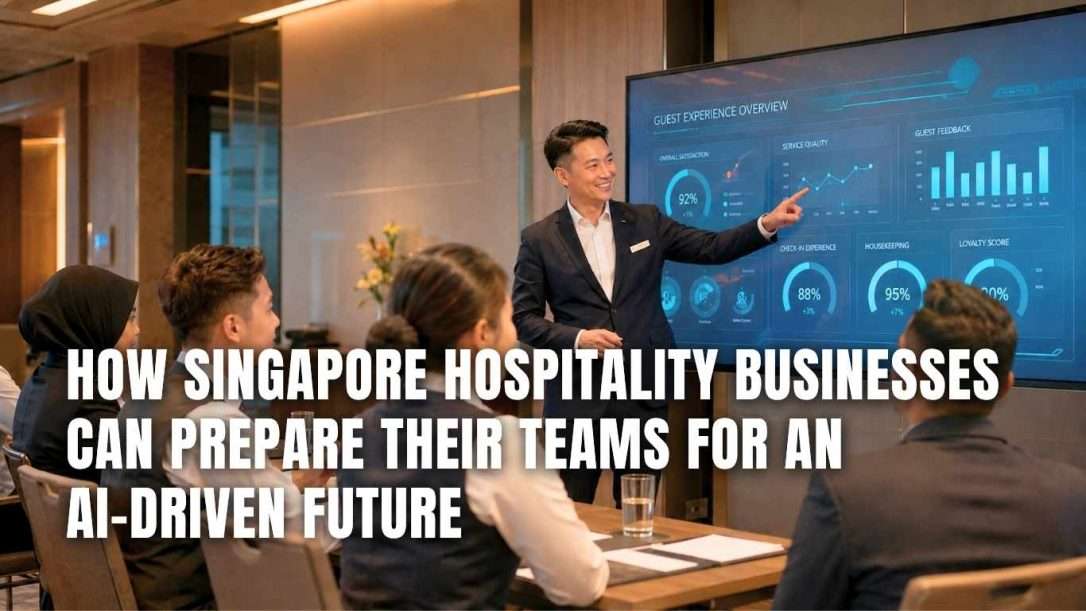

Artificial intelligence is no longer a distant idea in hospitality. It is already shaping how businesses manage bookings, respond to enquiries, forecast demand, analyse guest data, and streamline parts of daily operations. At the same time, Singapore’s hospitality sector continues to push for innovation, sustainability, stronger capabilities, and a more resilient workforce. Singapore Tourism Board’s Hotel Industry Transformation Map 2025 highlights innovation, sustainable growth, and workforce resilience as core priorities, while Workforce Singapore’s hotel Jobs Transformation Map points to changing guest expectations, sustainability, competition, and changing workforce aspirations as major forces reshaping hotel jobs.
That means the real question for hospitality businesses is no longer whether AI will change the industry. It already is. The better question is this. How should hospitality businesses prepare their teams so they stay valuable, effective, and deeply relevant in an AI-driven future?
The answer is not to train people to compete with machines at machine-like work. It is to train them for the areas where human capability becomes even more important. In hospitality, that means service judgement, communication, empathy, recovery, leadership, operational discipline, and the ability to use technology without losing the human touch.
AI is not the only change hospitality teams are facing
It would be a mistake to think AI is the only force shaping the future of hospitality. Hospitality businesses in Singapore are also operating in a sector that is growing, becoming more competitive, and facing higher expectations from guests and employers alike. Singapore’s tourism sector recorded 16.9 million international visitor arrivals in 2025, while tourism receipts for the first three quarters of 2025 reached a record S$23.9 billion for that period. These are not small signals. They point to an industry that is active, commercially significant, and under pressure to deliver better experiences at scale.
At the same time, STB continues to emphasise capability building, digital transformation, sustainability, and a future-ready workforce. In other words, hospitality businesses are not preparing for one trend. They are preparing for several at once. AI happens to be one of the most visible.
This is why a narrow approach to training is no longer enough. Businesses cannot train teams only for routine execution and hope that will carry them through the next phase of industry change.
What AI is likely to change in hospitality operations
AI works best when the task is structured, repeatable, and based on patterns. In hospitality, that can include:
- handling routine guest enquiries
- summarising customer feedback
- assisting with reservation workflows
- helping with pricing and forecasting support
- generating standardised responses
- organising information for staff faster
- identifying patterns in guest preferences or operational data
These changes fit what Singapore’s hotel and food services transformation work has already been pointing toward. Workforce Singapore’s materials on hotel and food services transformation describe the growing role of digital technologies, data analytics, redesigned jobs, and new roles linked to customer insight, sustainability, and revenue performance.
This means some parts of hospitality work will become easier, faster, or more automated. But that does not mean the whole value of a hospitality team disappears. It means the value shifts upward.
What AI cannot replace in hospitality
This is where many businesses get the issue wrong.
They assume the main goal is to make teams more efficient. Efficiency matters. But hospitality is not judged only by efficiency. It is judged by how people feel, how problems are handled, how smoothly pressure is managed, and how confidently teams respond when situations become less predictable.
AI can assist with information. It cannot truly replace human judgement in moments like these:
- a guest is upset but trying to remain polite
- a family needs reassurance, not just an answer
- a service lapse needs recovery, not a template
- a supervisor must decide when to bend, escalate, or adapt
- a team member needs coaching in tone, confidence, or timing
- a food safety lapse requires intervention and accountability
That is the lightbulb moment.
The future of hospitality does not belong to teams that only process tasks efficiently. It belongs to teams that can combine efficiency with warmth, judgement, composure, and trust.
The real risk for employers
The real risk is not AI itself.
The real risk is building a workforce that is only good at what can be standardised.
If staff are trained only to follow scripts, repeat processes, and stay within narrow routine boundaries, then more of their work becomes vulnerable to automation over time. But if staff are trained to think, interpret, reassure, anticipate, recover, and lead, their value rises rather than shrinks.
This matters because Singapore’s transformation work for hotels specifically points to redesigned roles and shifting expectations. Workforce Singapore notes that traditional hotel roles, including hotel managers and guest service associates, are being redefined, while digital technologies, data analytics, and sustainability are becoming more integral to how the sector operates.
That should be a wake-up call for employers. Training for the old version of the role is not enough. Businesses need to prepare staff for the emerging version of the role.
The skills hospitality teams now need more than ever
If routine tasks become easier to automate, then the most valuable skills become the ones that sit above routine work.
1. Customer communication
Frontline teams need to communicate with confidence, clarity, and emotional intelligence. This includes listening well, reading tone, adjusting language, and making guests feel understood rather than processed.
2. Complaint handling and service recovery
When service goes wrong, the best businesses do not simply resolve the issue. They recover trust. That requires calm communication, judgement, empathy, and the confidence to act.
3. Food safety and compliance discipline
In food services and hospitality operations, compliance remains non-negotiable. Singapore’s regulatory and industry direction continues to place strong importance on formal food safety capability and stronger hygiene systems. Food safety is not made less important by AI. If anything, stronger systems make human accountability more important.
4. Supervisory confidence
As roles evolve, supervisors need more than technical knowledge. They must coach staff, uphold standards, handle escalations, and maintain consistency under pressure.
5. Adaptability and problem-solving
Hospitality rarely unfolds in perfect scripts. The staff and managers who remain valuable are the ones who can respond intelligently when the unexpected happens.
6. Digital confidence without losing humanity
Teams do not need to fear AI. They need to know how to use it appropriately. That means understanding where digital tools help, where human intervention matters, and how to keep service from becoming mechanical.
How local hospitality businesses should respond
A strong response does not begin with buying more software. It begins with asking better questions about people, roles, and capability.
Step 1. Assess current skill gaps
Look honestly at where your team struggles today. Is it service tone, complaint handling, food safety discipline, leadership, confidence, or consistency across shifts?
Step 2. Identify which tasks are becoming more routine
Which parts of the role are likely to be supported by digital tools over time? These areas may need less training on repetition and more training on judgement.
Step 3. Retrain for higher-value capability
Train staff in the parts of hospitality that create trust, reduce risk, and strengthen guest experience. This includes communication, service recovery, leadership, customer handling, and compliance.
Step 4. Strengthen supervisors and managers
Frontline transformation often succeeds or fails at the supervisory level. Supervisors need the skills to coach, interpret, intervene, and lead teams through change.
Step 5. Build a long-term workforce development plan
Training should not be a one-off reaction to immediate problems. It should be part of a wider plan to help teams stay effective as the industry evolves.
This long-term view also aligns with how Singapore’s hotel transformation efforts frame the future. STB’s industry direction is not about isolated fixes. It is about building a more innovative, sustainable, and resilient sector over time.
Why training matters even more in an AI-shaped industry
Some businesses may assume that more automation means less need for training.
The opposite is more likely to be true.
As technology handles more routine work, human performance becomes more exposed. Guests will notice tone more. Managers will need sharper judgement. Teams will need stronger consistency. Compliance expectations will not disappear. Leadership gaps will become more costly.
That means training becomes more strategic, not less.
Businesses that only automate may become faster. But businesses that combine technology with strong human capability become more resilient, more trusted, and more distinctive.
That is the real competitive edge.
How Singapore Institute of Hospitality (SIH) can help
This is exactly where Singapore Institute of Hospitality (SIH) becomes relevant.
In an AI-driven future, hospitality businesses do not just need more tools. They need stronger people.
SIH can support that by helping businesses build practical workforce capability in the areas that matter most, including customer service, service excellence, food safety, supervisory development, and hospitality operations. These are the skills that do not lose value when technology advances. They often become more important.
For employers, this matters on several levels.
A business may need to strengthen frontline communication. Another may need more confident supervisors. An F&B operator may need stronger food safety capability and more consistent standards. Another company may want to customise training around specific operational gaps. In all of these cases, the goal is the same. Build teams that can perform well in a changing environment, not just survive in it.
That is why training should not be seen as a side activity. It should be seen as part of business readiness.
The future of hospitality will still be human
AI will change hospitality. That much is clear.
But it will not remove the need for people who can reassure, think, adapt, coach, lead, recover trust, and uphold standards. If anything, those qualities may become even more important as routine tasks become easier to automate.
The hospitality businesses that thrive will not be the ones that use technology to strip humanity out of service. They will be the ones that use technology to support better service, while continuing to invest in the human skills that guests, teams, and operations still depend on.
That is the real future of hospitality.
And that is why the smartest businesses will start preparing their teams now.
Explore Singapore Institute of Hospitality (SIH) programmes here:
https://sih.edu.sg/programmes/
Learn more about customised programmes here:
https://sih.edu.sg/customised-programmes/
FAQ
Will AI replace hospitality staff in Singapore?
AI is more likely to automate structured and repetitive tasks than replace the full value of hospitality teams. Roles that rely on judgement, service recovery, leadership, compliance, and human communication remain important.
What skills do hospitality workers need in an AI-driven future?
The most valuable skills include communication, service recovery, emotional intelligence, leadership, food safety discipline, adaptability, and the ability to use digital tools appropriately. These align with the broader direction of Singapore’s hospitality transformation efforts.
Why should hospitality businesses keep investing in training if technology is improving?
Because as technology handles more routine work, human performance becomes more visible. Businesses still need strong judgement, service quality, compliance, leadership, and consistent execution.
How can hospitality employers prepare staff for AI?
They should assess current skill gaps, identify which tasks are becoming more routine, retrain for higher-value capability, strengthen supervisors, and build a longer-term workforce development plan. This is consistent with Singapore’s broader push for workforce resilience and job redesign.
How can Singapore Institute of Hospitality (SIH) help employers?
SIH can help employers strengthen practical capabilities such as customer service, food safety, supervisory development, and customised training support for business-specific operational needs.